A Film Image, Reimagined as a Three-Minute Sketch
A film image three-minute sketch turns a remembered frame into a loose drawing of mood and shape, with a simple method for starting without artistic pressure.
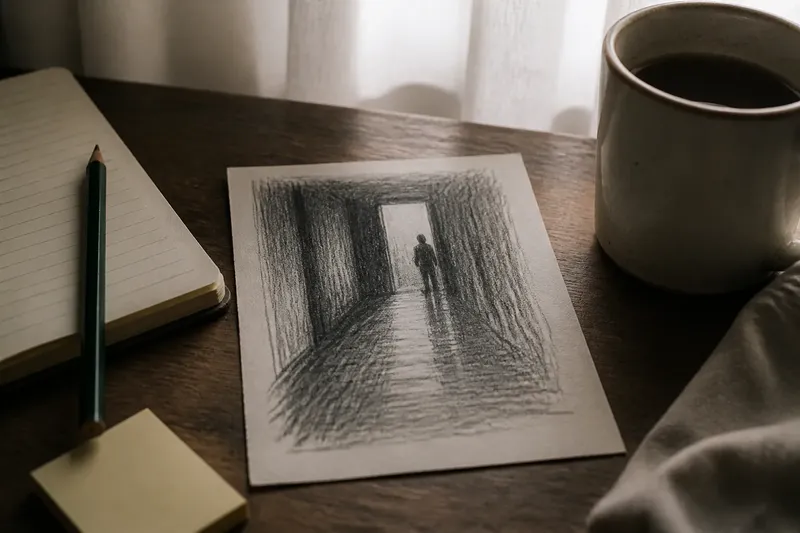
The kettle clicks off while a blue doorway from last night’s film is still sitting in your head. You remember the bright rectangle, a small figure near its edge, and the feeling that the room behind it was holding its breath. A film image three-minute sketch can start there, without a screenshot, a drawing course, or any obligation to make the doorway look like a doorway.
Keep the remembered frame
The point is to draw what the image left behind, not reconstruct the shot. Film images arrive with lighting, movement, sound, and story attached; memory has already begun sorting those ingredients. A quick sketch gives that sorting somewhere to go.
Choose one image that comes back without much effort. It might be a face half-hidden by a curtain, a staircase disappearing into shadow, or a bright cup on a crowded table. The image need not be the film’s most important moment. In fact, a minor detail can be easier to hold because it has not been recruited into a plot summary.
Set out scrap paper and an ordinary pencil, pen, or marker. A sticky note, the back of an envelope, or the margin of a notebook will do. Use a timer if it helps you stop; leave it alone if watching a countdown would turn a small drawing into a minor emergency.
Imagine the doorway
Say you watched an invented, hypothetical film about a night-shift caretaker. One image stays with you: a narrow blue doorway at the end of a gray corridor, with the caretaker’s silhouette just outside it. You cannot recall the actor’s face, the corridor’s exact layout, or what happened next. What remains is a feeling of hesitation, and that is enough to begin.
You place a small rectangle near the top of a scrap page, then draw a long, uneven band beneath it for the corridor. The figure becomes a dark vertical shape beside the rectangle. You use the pencil’s side to cloud the space around the doorway, then leave the figure mostly unmarked. When the timer rings, the paper holds a contrast between an opening and someone who has not entered it.
That result is not a miniature version of the film. It is a record of which parts your attention kept: the opening, the waiting figure, the dull hallway, and the pause between them. Someone else might remember the caretaker’s shoes or the color of the wall. Your sketch can be useful without matching theirs.
Three minutes of choices
Give the drawing a beginning, middle, and stop point. The sequence is deliberately small:
- Choose one anchor. Write a plain noun at the top of the page if you need one: window, hand, lamp, bridge, or face. An anchor keeps the sketch from expanding into a map of the entire film.
- Block in the largest shapes. Use a few broad marks for the main light, dark area, and subject. A shadow can be a wedge; a room can be a box. Exact perspective is optional, and often a distraction.
- Add one relationship. Show where the subject sits in relation to another shape: beneath a light, across a gap, behind a doorway. The distance between things may carry more mood than their details.
- Stop and name the mood. Add a short word beside the sketch, such as “waiting,” “exposed,” or “too quiet.” Do not explain the scene or improve the drawing after the timer ends unless you genuinely want to continue.
The noun and mood word are small handles, not a verdict on the film. They help you notice what the image is doing for you. A crooked line can suggest unease; a wide blank area can make a small figure seem alone. Neither needs to be decoded into a single correct meaning.
Draw mood through shape
When accuracy is not the goal, a few visual decisions do most of the work. Start with scale: make the remembered person tiny against a large wall, or let a hand fill nearly the whole page. Scale can shift the feeling from intimate to exposed without adding a single facial feature.
Try edges next. A hard, dark boundary may feel settled or severe; a broken outline can feel uncertain. Use spacing to show distance: leave an open strip between two shapes, or crowd them until the page feels compressed. These are choices, not a codebook. The same blank space can feel peaceful to one viewer and ominous to another.
Light can be treated as a shape rather than a realistic glow. Leave a patch of paper untouched for a lamp, doorway, or window, and darken the area around it. If the scene’s color is what you remember, write the color name in the margin or shade a rough area with a colored pencil. A monochrome sketch can still begin with “green,” “amber,” or “cold white.”
Work with the tools already at hand. A soft pencil makes broad shading easy; a ballpoint pen favors decisive lines; a marker can turn a small shape into a strong silhouette. You do not need a special sketchbook or a collection of drawing supplies. Buying materials before making a mark is an efficient way to postpone the mark.
What can I draw from memory?
What if I remember only a color?
Make that color the anchor: draw a block, stripe, or loose patch, then place one simple shape beside it. Add a mood word to help distinguish the remembered color from a decorative swatch.
Do I need to remember the whole scene?
No. One object, silhouette, or patch of light is enough to start. Leave out everything you cannot recall rather than filling gaps with details that belong to a different scene.
What if I cannot draw people?
Replace the person with an oval, a dark mark, or a gap where the figure stood. The sketch is about the image’s arrangement and feeling, not a likeness suitable for an identity check.
Should I look up a still afterward?
For this exercise, leave the image in memory. A still can be useful for a separate study of composition, but checking it now changes the task from remembering into copying.
Read the marks afterward
When the sketch is done, look at it for a few seconds and ask what the page emphasizes. You may notice that the doorway is wider than it seemed in memory, or that the figure has drifted toward the edge. That is not a correction request. It is a clue about how you have arranged the image in your mind.
If a mark feels wrong, name the mismatch rather than repairing it automatically. Perhaps the scene felt open but the drawing feels cramped. Perhaps the remembered light was gentle, while the dark outline looks blunt. A quick note such as “more space” or “softer edge” can preserve the observation without starting an unplanned second session.
Imagine the caretaker sketch leaves you curious about the empty corridor rather than the figure. On another scrap, you might draw only the corridor’s long band and the blue rectangle, letting the figure disappear. The expected visible result is a page with more space and less human presence; the point is not to prove which version is correct, but to notice how changing one shape shifts the mood.
Keep the pressure low
Three minutes is a boundary, not a performance target. If you finish early, stop. If you miss the timer because you were deciding whether a shadow should be a wedge or a smudge, stop when you notice. The exercise works best when the drawing stays small enough to invite another one later.
It is not worth erasing every awkward line, searching for the exact frame, or grading the result against a polished illustration. Those tasks answer different questions. Here, a lopsided rectangle may be more useful than a faithful corridor if it preserves the feeling of waiting at a threshold.
You can keep the sketch beside a ticket stub or tuck it into the notebook where you jot down film titles, but storage is optional. The useful part is the pause between remembering and making: a remembered film image becomes a few shapes you can inspect. Next time a frame follows you into an ordinary room, the film image three-minute sketch gives it somewhere modest to land.