The One-Question Film Club
A one-question film club gives your group a clear starting point, a lighter hosting plan, and room for a real conversation after the credits.
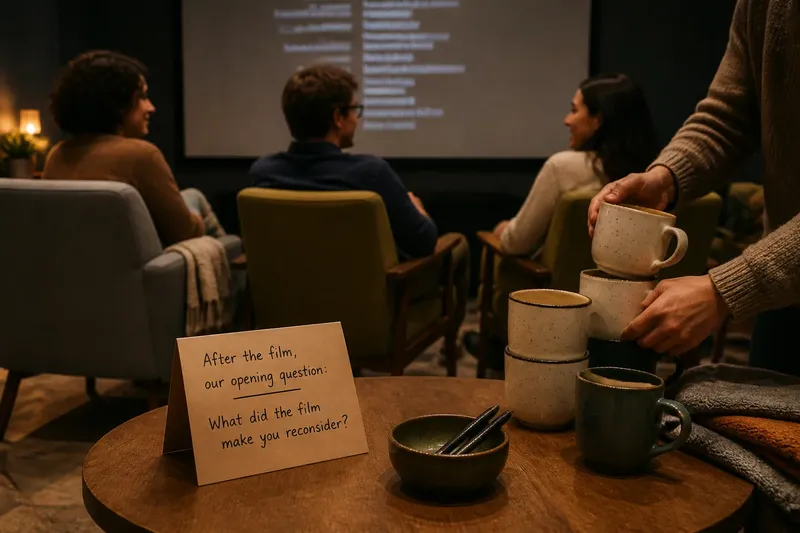
The chairs are still pointed at the screen, someone is stacking mugs, and the credits have started to roll. A one-question film club gives the group a clear starting point without turning the evening into a seminar with snacks. The useful work happens before the screening: choose one open-ended question, then let the film and the people in the room supply the rest.
This format suits a small gathering, a library group, or friends who want to talk without preparing notes. It is not a ban on follow-up questions. It is a way to give the conversation one shared doorway instead of handing everyone a different key.
Choose the question first
Begin with the question, not a list of discussion topics. A strong prompt can hold several possible answers and invite people to point to moments in the film. “Was the ending good?” mostly asks for a verdict. “What did the ending make you reconsider?” leaves room for conflicting readings and for a reply grounded in a scene.
Keep the wording short enough to remember. It should concern something viewers can encounter in the film—such as a character’s choice, a recurring image, a shift in tone, or the way information is withheld—without telling them what they are supposed to notice.
Try these checks while drafting:
- Does it invite more than one reasonable answer? If the question has an obvious correct response, open it up.
- Can viewers refer to specific moments? A prompt that floats away from the film may lead to a pleasant conversation about anything except the film.
- Is it answerable without specialist knowledge? The group should not need a glossary or a degree in camera movement to join in.
- Does it avoid prescribing a reaction? “Why is this character admirable?” assumes the character is admirable. Ask what the character’s choices reveal instead.
- Can you say it once and leave it alone? If it needs several clauses and a footnote, simplify it.
For a film centered on a difficult decision, “What makes this choice feel possible to the character?” may open more doors than “Did the character do the right thing?” The second question can still lead somewhere, but it tends to sort people into verdicts before they have described what they saw.
Match it to the screening
Choose a question that fits the film’s texture, not only its subject. A quiet story might invite attention to what characters leave unsaid. A comic film might raise questions about who is allowed to set the terms of a joke. A suspenseful film could prompt viewers to consider what they were led to expect and when.
Avoid trying to make one question cover every interesting feature. If you want to discuss the score, the costumes, the ending, and the director’s intentions, you have already made an agenda and given it a false mustache. Choose the aspect that is most likely to keep opening up as people compare their attention and interpretations.
Give the group the prompt before the film, but do not explain your preferred answer. A brief announcement is enough: “Afterward, we’ll talk about what the film lets us know and when.” Then let people watch. The question can gently orient attention without becoming an assignment to take notes.
Say you are hosting a film about two siblings preparing to leave their family home. You choose, before the screening, “Which object seems to carry the most between the siblings?” Viewers may notice a key, a photograph, or something you did not have in mind; the conversation can then compare what those objects mean in their respective scenes. The prompt has a focus, but it does not require everyone to find the same object.
Set a modest frame
Before pressing play, tell guests how the discussion will work. Explain that there is one opening question, anyone may pass, and no one needs to arrive with a polished interpretation. If the group is used to formal discussion, clarify that this is a deliberately compact format, not an incomplete program.
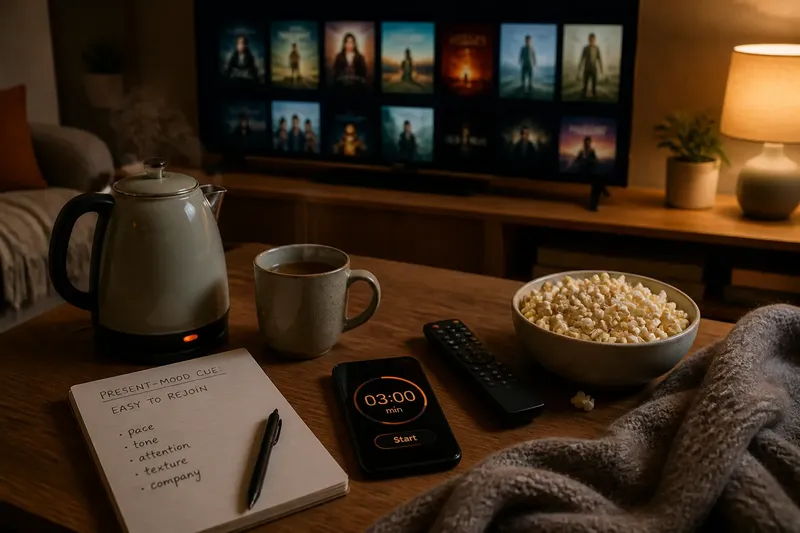
Make the physical setup help rather than distract. Arrange seats so people can see one another after the screening, and leave the question somewhere easy to consult—a card beside the remote or a note on the table. A small bowl of pens is optional; asking people to write down their response is not. The point is to make conversation easier, not to add homework in a nicer font.
Agree on a loose stopping point. A host can say the group will talk until the conversation has had time to breathe, then close when people begin repeating themselves or energy fades. No timer is required. If your gathering needs a firm end, state the boundary plainly before the film rather than cutting someone off mid-thought.
Start with silence
Once the credits have finished, give the room a moment. People may still be sorting through what they saw, and the first person to speak can accidentally set a tone everyone else feels obliged to follow. A brief pause is not dead air; it is the small space between viewing and explaining.
Then read the question as written. Avoid adding your own interpretation, even as a friendly example. “I was thinking about the scene with the blue coat” may sound like a helpful starting point, but it can steer everyone toward that scene before they have chosen their own evidence.
Ask for an opening response from anyone who wants to begin. If no one moves, offer a low-pressure alternative: people can name a moment that stayed with them before attempting an answer. That still keeps the group near the film and gives quieter viewers a way in without demanding a thesis statement.
Let replies build
Listen for what each person is actually responding to. When someone mentions a scene, invite them to say what in it shaped their reading: a gesture, a cut, a line, a repeated object, or a change in how the characters share space. This is more useful than asking them to defend a position as if the meeting were a courtroom with better lighting.
Use follow-ups sparingly. “Did anyone read that moment differently?” makes room for another view. “What makes you say that?” can help a person expand an idea, but repeated too often it starts to sound like a cross-examination. A host can also connect two comments: “You both noticed the locked door, but one of you saw it as protection and the other as a barrier. What changes that reading?”
Keep disagreement attached to interpretations, not to a person’s right to have one. The group can ask whether a reading accounts for a scene or whether another moment complicates it. There is no need to declare a winning interpretation; films do not issue certificates at the door.
Some viewers will speak readily, while others may prefer to listen. Do not assign turns or ask a quiet guest to explain their silence. If the same voices dominate, redirect gently toward the group: “Let’s hear from anyone who hasn’t spoken yet, if they’d like to.” A pass remains a complete answer.
Common questions?
What makes a good film club question?
A good question invites several plausible interpretations and keeps answers connected to observable moments in the film. It is short, neutral in tone, and open enough that a viewer can disagree without first rejecting the wording.
Should the group know the question before watching?
Usually, yes, if the aim is to give attention a gentle direction. Share the wording without naming the answer you expect; if you want a more unprompted first viewing, reveal the same prepared question after the credits and keep the rest of the format unchanged.
What if nobody answers at first?
Wait briefly, then invite people to name a moment that might connect to the question. You can restate the prompt more simply, but avoid supplying an interpretation that the group may then feel obliged to adopt.
Can a one-question discussion include follow-ups?
Yes. Follow-ups help people clarify, compare, or complicate their answers, while the opening question remains the conversation’s center. If the group moves to a genuinely separate subject, acknowledge it and decide whether to return to the prompt or let that thread stand.
Close without a verdict
When the discussion begins to circle, do not rescue it with a new topic. Ask whether anyone has a final thought about the original question, then let the answer be brief. A useful ending may be a shift in how someone sees a scene, not a shared conclusion.
You can close by naming the range of answers you heard without ranking them: several people focused on what the film withheld, while others noticed what its characters repeated. That gives the evening a shape without pretending everyone arrived at the same place. Thank the group, collect the mugs, and leave the question behind rather than assigning a second one on the way out.
For your next one-question film club, keep the main phrase simple: one open-ended film club question, chosen before the screening. Put it where you can read it aloud, then trust the room to make something of it. The part not worth the effort is a polished host’s speech; the film and the prompt have already done enough setup.