What a Film’s Unanswered Ending Lets Viewers Do
An unresolved film ending can invite interpretation without leaving the story unfinished; learn how to distinguish deliberate openness from missing answers.

The screen goes dark just as two characters reach the station doors. One turns toward the platform; the other stays beside the ticket machine. The film has not told you what happens next, but it may have given you enough to decide what that pause means. An unresolved film ending can hand viewers interpretive work without simply stopping the story.
What makes an ending unresolved?
An unresolved ending leaves a meaningful question open: what a character chooses, what an event means, or how two possibilities fit together. It can withhold a clear outcome while still completing the film’s central movement. The distinction is not whether every detail gets explained, but whether the ending has shaped the uncertainty into something the viewer can think about.
A story that cuts off before its central conflict changes may feel unfinished because the scene has not yet delivered a turn, consequence, or deliberate stopping point. An open ending can instead bring a conflict to a recognizable threshold. The character reaches a decision, faces its cost, or sees the situation differently, even if the film does not show the next event.
Consider a story about a woman deciding whether to return to her hometown. If the final scene shows her packing one box and leaving the rest untouched, her eventual destination may stay uncertain. Yet the image can complete a shift from avoidance to readiness. The next plot event is withheld; the character’s altered relationship to the choice is already visible.
Why leave the answer open?
Some stories are more interested in the pressure of a choice than in its outcome. Showing the decision’s consequences would narrow the question to plot logistics: who goes where, who calls back, who gets the last word. Ending at the point of choice keeps attention on what the decision costs and what it reveals about the person making it.
Openness can also preserve competing interpretations that the film has prepared rather than invented at the last moment. A final image may support both hope and dread because earlier scenes have made each reading plausible. That is different from vagueness for its own sake: the ambiguity has roots in the film’s characters, visual details, or recurring tensions.
Think of a character who has spent the film hiding evidence of a past mistake. In the last scene, they place the evidence on a desk but leave before anyone else enters. One viewer may read the gesture as an attempt to confess; another may see it as a way to transfer the burden without facing the consequences. Both readings attend to the action. Neither needs a secret clue that the film never supplied.
How can viewers tell it is deliberate?
Deliberate openness usually gives uncertainty a shape. The final scene echoes an earlier image, brings a relationship to a changed point, or concentrates the film’s central conflict into one last choice. These features do not prove what the filmmakers intended. They give viewers concrete material for deciding whether the ending’s silence feels composed or merely abrupt.
Look at what has been answered as well as what remains open. The film may settle who knows the truth, where a character stands, or which values are in conflict while leaving the future unsettled. If the ending changes the meaning of an earlier scene, or makes a familiar image feel newly charged, it has likely done more than stop.
An abrupt cut can still be purposeful, and a neatly resolved plot can still leave emotional questions behind. The useful test is not whether the ending feels satisfying on first viewing. Ask whether the last scene gives the open question a specific form, and whether that form connects to something the film has already developed.
What should remain unresolved?
The strongest open endings tend to leave a question that matters to the film’s subject, not a pile of unrelated facts. A question about trust, responsibility, grief, or belonging can sustain interpretation because it reaches beyond the next plot beat. By contrast, withholding a basic piece of information may create suspense without adding much to the film’s meaning.
That does not make unanswered plot questions automatically poor choices. A film can leave the source of a sound or the identity of a stranger unclear because the uncertainty itself changes how the characters behave. But if a missing fact has no effect on character, mood, or theme, viewers may reasonably treat it as an unfilled gap rather than an invitation.
Say you have just watched a film in which a brother leaves a voicemail after years of silence. The scene shows the message arriving but not whether his sister listens. You could ask what the film has already shown about her willingness to hear him, then offer two readings: she listens and risks reopening the relationship, or she leaves the message untouched as a boundary. The exchange stays tied to a visible choice and its emotional cost, rather than becoming a contest to guess an unseen plot.
Can viewers disagree and both be right?
Yes, when each interpretation accounts for the same on-screen details and acknowledges what the film leaves unknown. Viewers can disagree about whether a character’s silence signals fear or resolve, for example, while agreeing that the silence is the final action the story gives them. The disagreement becomes less useful when one reading depends on a fact absent from the film and treats that invention as established.
Separate observation from inference. “She puts the letter in the drawer” describes an action; “she plans to answer tomorrow” adds an intention the film may not confirm. Keeping those layers distinct makes room for different readings without pretending every possibility has equal support.
Imagine two viewers discussing a final shot of a locked bedroom door. One argues that the character is protecting a private life; the other thinks the door marks a retreat from a difficult conversation. If both can point to earlier scenes that support their reading, the ending has made discussion possible. They do not need to settle which answer is correct before the credits finish doing their quiet administrative work.
What questions help after the credits?
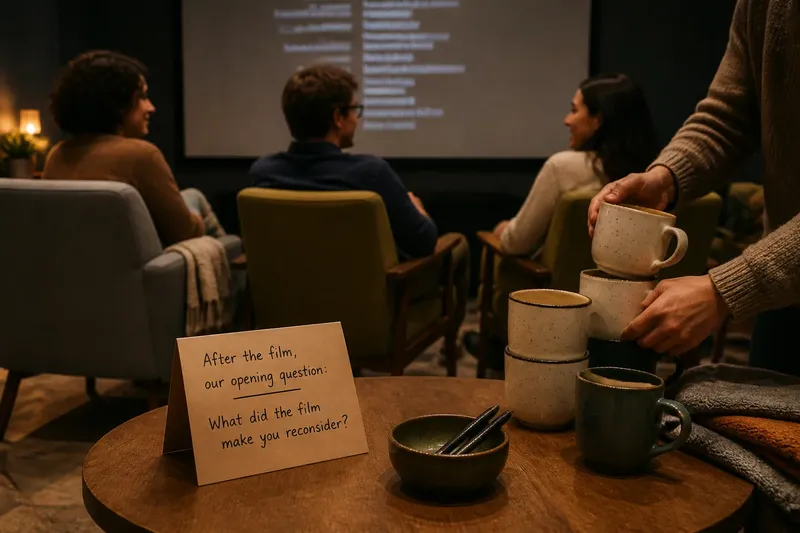
Start with a question grounded in the ending’s actual choices, then let interpretation follow. These prompts keep the conversation on the film rather than turning it into a vote on the “right” answer:
- What changed before the final scene? Name a shift in knowledge, loyalty, or willingness that makes the ending feel different from an earlier moment.
- Which detail carries the most weight? Choose a gesture, object, line, or repeated image and explain what it could mean in context.
- What does the ending answer clearly? Identify a point the film settles before discussing what it leaves open.
- Which interpretation asks for the fewest invented facts? Compare readings by how closely they follow the actions and details on screen.
It is not worth forcing a single solution out of every ambiguous image. Some endings are built to hold several readings, and a conversation can remain productive without appointing one viewer as the keeper of the official answer. If discussion stalls, return to the scene itself: what happens, what changes, and what question remains consequential.
How is openness different from incompletion?
An open ending leaves viewers room to interpret a shaped story; an incomplete-feeling ending may leave essential dramatic work undone. The difference often appears in the final scene’s relationship to the film’s larger arc. Has a character reached a new position? Has a central tension sharpened or changed? Does the last image gather earlier concerns into a deliberate stopping point?
Those questions are more reliable than asking whether the ending supplies a tidy answer. A film can close its emotional argument while leaving events uncertain, or resolve the plot while keeping its meaning unsettled. What an unanswered ending lets viewers do is not write the missing final chapter at random. It lets them examine the choices, images, and tensions already on screen—and decide which reading best accounts for them.
That distinction is useful the next time the credits arrive before the answer does. Begin with what the film has actually completed, then treat the remaining question as an invitation to interpret, not a form left blank by mistake.